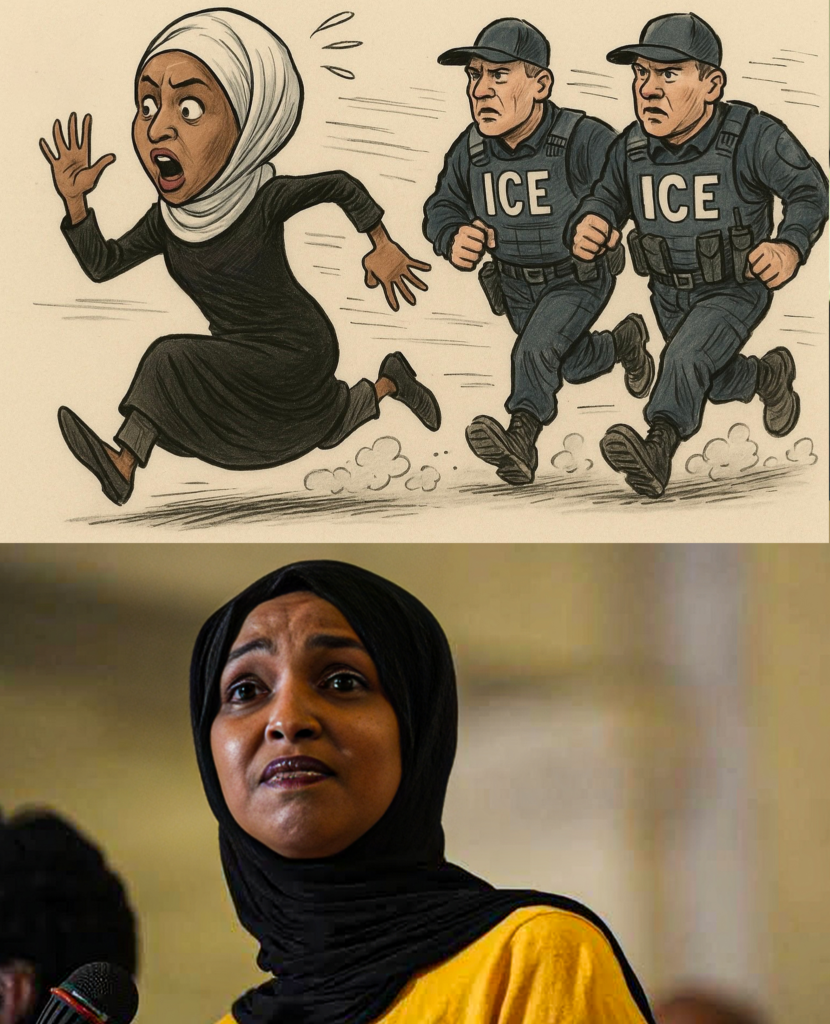
Ilhan Omar is walking into the biggest political storm of her career — and this time, the internet isn’t letting her breathe.

Her long list of highly controversial actions and statements has finally pushed millions of Americans to question how far a public figure can go before the system steps in.
Now the pressure is exploding online:
People are demanding investigations, policy reviews, and even asking whether someone who constantly sparks national outrage should continue holding the privileges of American citizenship.

The debate has turned brutal:
Is this free speech, or a direct challenge to the country that gave her everything?
Should consequences apply equally — whether it’s an ordinary citizen or a member of Congress?
As the calls grow louder, one question dominates the national conversation:

If someone repeatedly disrespects the values of the nation, should America still trust them with a seat in power?
This is more than politics…
It’s a battle over loyalty, law, and what America stands for.
Controversial Commentary – Part 1
The contrasting images—one a cartoon of a woman in a hijab running from immigration officers, and the other a real-life woman speaking with visible concern—have ignited a storm of debate about symbolism, bias, and how public discourse weaponizes imagery. Some viewers argue that the combination of these visuals is a deliberate critique of immigration enforcement, meant to expose the fear and vulnerability experienced by marginalized communities. Others insist the imagery is exaggerated, manipulative, or intentionally polarizing, designed not to illuminate real issues but to inflame emotional reactions.
The cartoon in particular has been criticized for flattening human experiences into caricatures, which some say oversimplifies a complicated political reality. Meanwhile, the photograph of the woman speaking—caught in a moment of intensity—has been interpreted in wildly different ways. To some, she represents resilience; to others, she symbolizes a community under pressure; and to critics, she is being exploited as a visual prop in a larger political narrative she did not choose.
What makes the entire composition even more controversial is the way it forces the audience to confront their own biases. Do people interpret the running woman as a victim because of her clothing and expression, or because the presence of law enforcement automatically frames her as someone fleeing oppression? Conversely, do some people assume guilt or wrongdoing simply because the cartoon places her opposite officers? The reactions reveal more about the viewers than the images themselves.
Social media has amplified the controversy. Some users see the juxtaposition as a bold statement about systemic injustice, while others accuse it of pushing a divisive agenda. The debate has become less about the actual images and more about what people are projecting onto them—fear, anger, sympathy, or political frustration. And as usual, the fiercest arguments come from those who are convinced their interpretation is the only “truth.”